We Serve Clients Nationwide, Call us at (855) 696-9802 to Reserve Your Samples Today
Your Materials Inspiration
Starts here.
Surface Shop is an expansive purveyor of exquisite natural stone products from around the globe. Whether you’re brushing up on the difference between marble and limestone on Surface Culture, our wide-ranging blog, or working with one of our national distributors on a personal project, we’re excited you’re here.
Stone veneer siding can make your home exterior look good if it seems a little flat, giving it texture, depth, and a high-end style that people normally associate with custom constructions. This article has seven Stone Veneer Siding Ideas that you can apply, whether you want a full front elevation or just tidy accent zones around your garage or entryway.
In this article, we’ll also cover what Stone Veneer Siding is, how it differs from full bed stone, and when Natural Stone Veneer Siding is the best choice. Let’s design your home exterior upgrade in a way that is simple, useful, and doesn’t waste time.
Why Choose Stone Veneer Siding for Your Home Exterior
Let’s make things easy: Stone veneer siding is a thin layer of stone that goes on the outside of your house to make it look like actual stone without the weight of full-thickness masonry. You can acquire it as natural veneer, which is thin pieces of real stone, or as produced veneer, which is man made products designed to look like real stone. So why do people love Stone Veneer Siding? Because it gives depth, texture and shadow to a home’s exterior greatly elevating the look and design when done well.
Thin stone veneer generally will weigh less than 15 pounds per square foot, but full building stone can weigh 40 to 60 pounds per square foot. That decreased weight makes installation easier and causes fewer problems with the structure. And yes, Natural Stone Veneer Siding is the “real deal” look. You get the random changes in color and texture that happen in nature.
Thin Stone Veneer vs. Full‑Bed Stone: What’s the Difference?
When discussing stone veneer siding, it’s important to clarify how it differs from traditional full‑bed stone. While both offer natural beauty and long‑term durability, they function very differently in exterior applications.
Thin stone veneer siding — the material featured throughout this article — is typically ¾” to 1¼” thick and significantly lighter than full‑bed stone. Because of its reduced depth and weight, it can be installed over properly prepared wall systems without requiring a structural footing or ledge. This makes thin veneer a practical solution for residential exteriors, remodels, and mixed‑material façades where structural flexibility and cost control matter. It delivers the authentic texture and variation of natural stone while remaining adaptable to modern construction methods.
Full‑bed stone, by contrast, is generally 3–5″ thick and substantially heavier. It is often used in traditional masonry builds and may require additional structural support due to its weight. Full‑bed stone provides a strong architectural presence and is ideal for load‑bearing or heavy masonry applications, but it typically involves higher material costs, increased labor, and more complex installation requirements.
For most residential exterior siding projects, thin natural stone veneer offers the most efficient balance of aesthetics, installation practicality, and overall value. It achieves the dimensional look homeowners want without the structural constraints associated with full‑depth masonry.
Quick Comparison
Thickness: Thin veneer (¾”–1¼”) vs. Full‑bed (3–5″+)
Weight: Thin veneer is significantly lighter
Installation: Thin veneer adheres to prepared wall systems; full‑bed may require structural support
Cost & Labor: Thin veneer typically reduces installation complexity and associated costs
Best Use Case: Thin veneer for exterior siding and accent applications; full‑bed for traditional masonry or structural builds
Understanding this distinction helps you choose the right material for your exterior upgrade — and ensures the design ideas shown above translate smoothly into real‑world construction.
In short, for exterior residential siding and accent work like what we show above, thin stone veneer gives you the look you want with less structural constraint and often better value than full-bed stone — which remains better suited for heavy masonry or load-bearing stone builds. Below, we’ll focus exclusively on thin stone veneers.
7 Stone Veneer Siding Ideas
This is the fun part. These ideas for natural stone veneer siding range from “small upgrade, big difference” to “wow, did you build a new house?” You can use them to fit your style, budget, and how daring you want to be from subtle accents to bold, full-elevation designs.
1. Full Front Elevation in Stone Veneer Siding
Custom Platinum Linear Lavastone
Stone Veneer Siding all over the front of the house will give it the most curb appeal. This is the “main character energy” choice.
Best For: Modern farmhouse, contemporary, cabin-inspired, and craftsman homes.
Why It Works: People view the front elevation first and judge your home immediately. Stone embodies a high-end luxe look.
Design Tip: Keep trim and fascia simple so the stone texture stays the star.
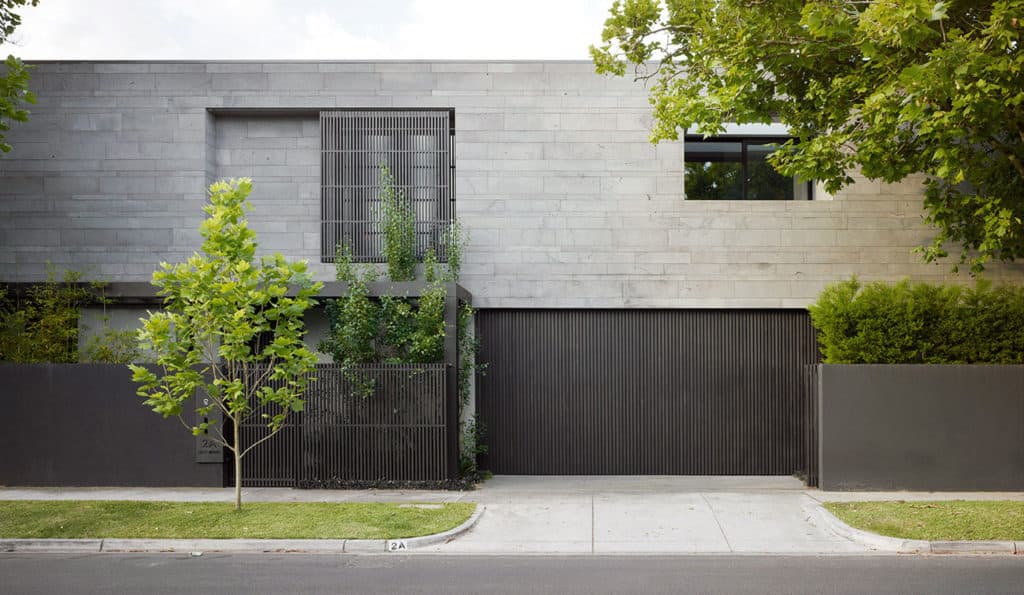
If you use Stone Veneer Siding, embrace its inherent differences. The small blend of colors or the natural veining present in the Platinum Planc Large Format Tile on this exterior, is part of the beauty of natural stone that can’t be replicated by manmade products.
2. Stone Veneer Siding on the Lower Half of Exterior Walls
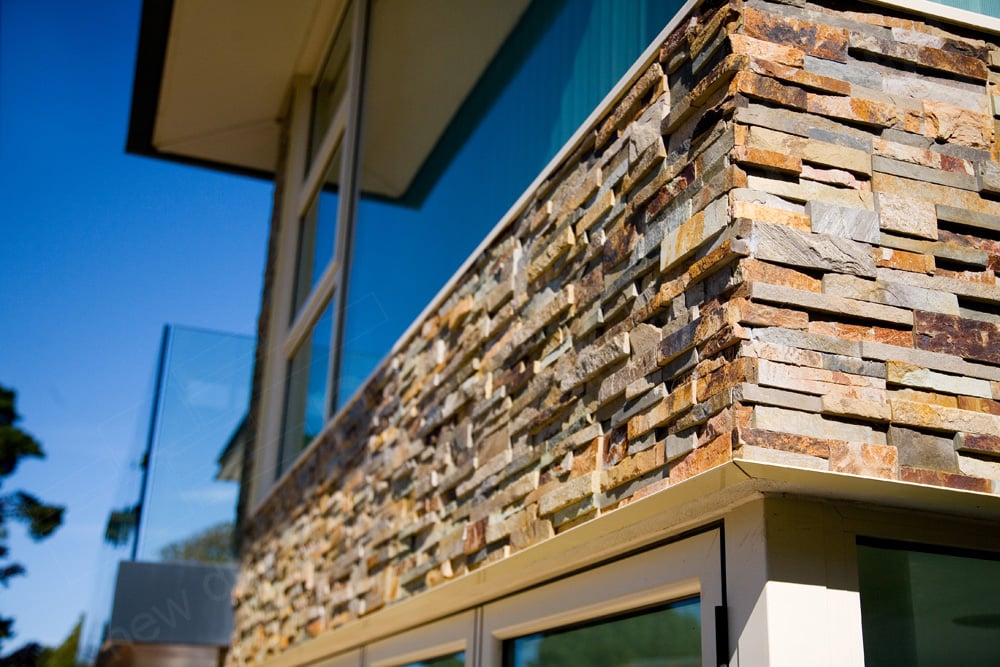
Ochre Stacked Stone 3D Panels For Siding
Stone on the bottom half of a wall with another material on top is the typical “wainscoting” style. It’s useful and smart.
Why Homeowners Like It: It gives the look of a sturdy base and keeps places that get a lot of use safe from bumps, splashes, and other things that happen in life.
Why Designers Like It: It gives lofty walls a base and creates contrast without covering everything.
Budget Win: You get the stone effect without having to buy as much material as a full façade.
This is one of the Natural Stone Veneer Siding Ideas that costs the least, especially when you use stone with fiber cement, lap siding, or board-and-batten above. Stacked Stone Wall Panels are an excellent choice for a wainscoting application as they add tremendous texture to the base to contrast with smoother surfaces above.
3. Stone Veneer Siding Accents Around Entryways and Garages
Sun Valley STRATA™ Limestone is the Perfect Compliment on this Modern Home
Think of your entryway as a picture frame. Stone veneer siding can be that frame.
Wrap the space around the entrance door to make it feel warm and fancy.
Put stone around the garage door to make it look more planned and less like a big blank panel.
Use the same kind of stone in both places to make the house feel “tied together.”
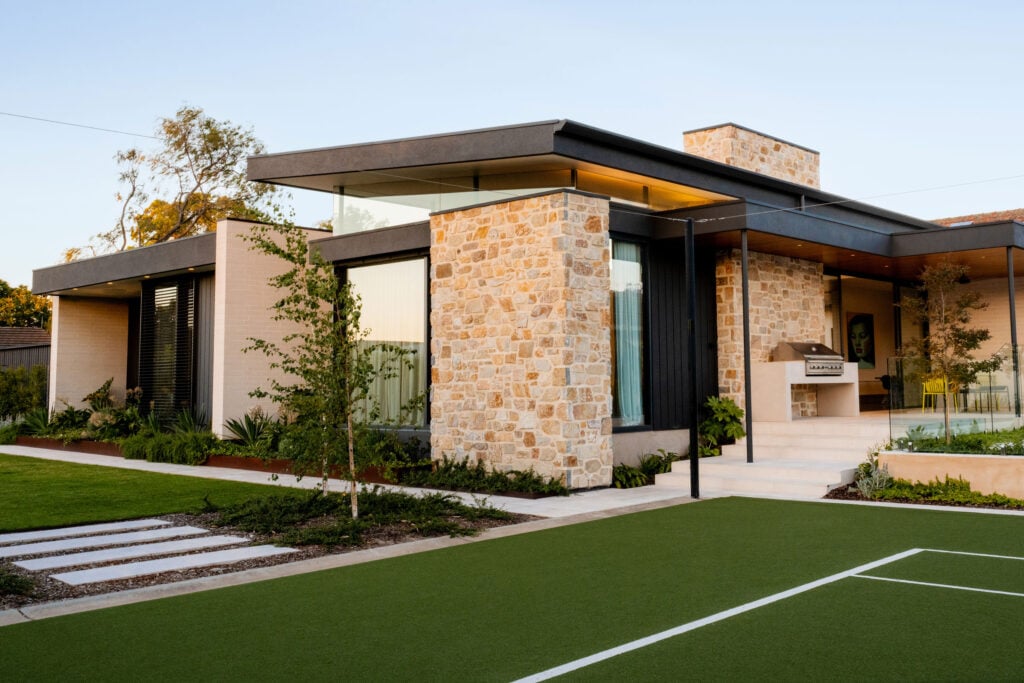
A lot of curb appeal posts forget this: you don’t have to stone everything. Just stone the places where your eyes land first like we see with this stunning Texas lake home that has used Sun Valley Strata Large Format Tile around the door and garage.
4. Stone Veneer Columns, Pillars, and Porch Bases
Ivory Quartz Rock Panels Used as Stone Columns on this Coastal home in Fort Myers Florida
Porch posts that are plain can look incomplete. Stone Veneer Siding is a quick remedy to class up porch columns or bases.
Where It Shines: Front porches, carports, and covered patios.
What It Adds: A stronger look and a more “built-in” feel.
Pro Tip: To make it look like it was planned, match the stone on the columns with a little part of the home base.
An excellent outside corner solution like the finger jointed corner units available in Surface Shop’s Stone Panel Systems are an important part of any column installation to make the install look complete and seamless.
5. Chimneys, Gable Ends and Peak Accents in Natural Stone Veneer Siding
Ochre Blend Stacked Stone Wrap around Base of Home in Colorado
Want a strong detail without covering everything in stone? Place Natural Stone Veneer Siding on the chimney, gables, peaks, or upper-story accent areas of a residential exterior.
Why It Works: Chimneys, gables and peaks are already a “feature zone,” so stone there looks natural.
How To Keep It Modern: Choose cleaner stone profiles and limit extra trim lines.
Where Else To Try It: Dormers, bump-outs, second-story accent panels.
These types of Stone Veneer Siding Ideas often get overlooked as they are above the roof line, but are a great opportunity to change the look of a home from multiple angles as the height of these spaces allows them to be seen from multiple angles.
6. Mixed-Material Exteriors with Stone Veneer Siding and Wood or Metal
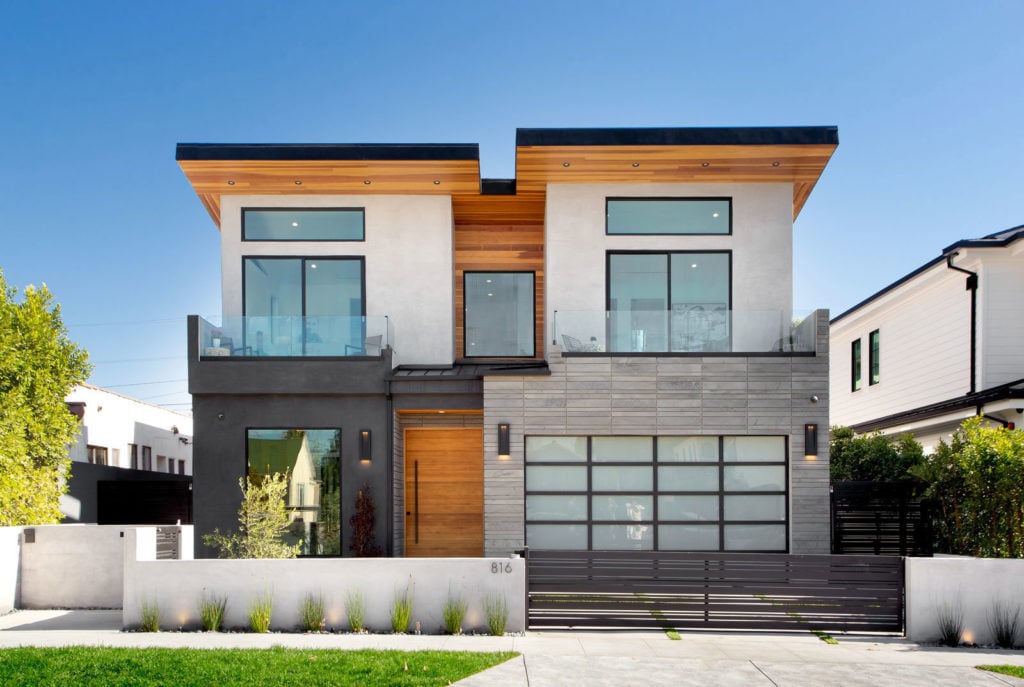
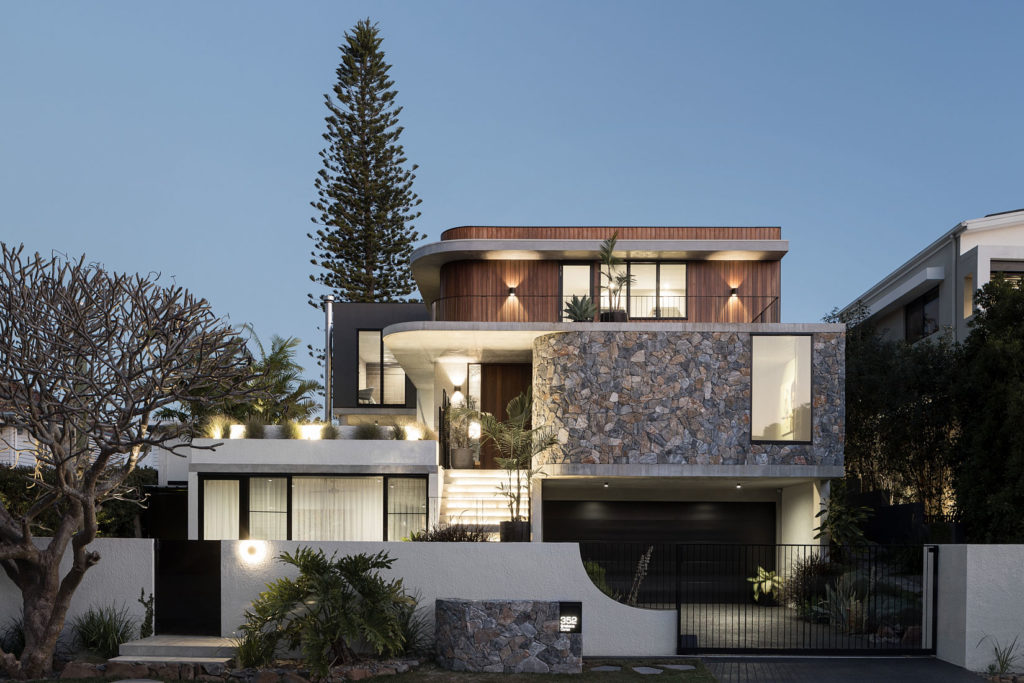
Soldier Stacked Coursing of Platinum PLANC Lavastone Strips used on this two story transitional style home in West LA
To create that custom-architect look, you need to mix materials such as wood and stone, stone and metal or textured stone and smooth stone panels. It is contrast done right.
Here’s what to look for:
Choose one “main” material and let the others complement it.
Use stone where you wish to add weight, including on base walls, entryways, and chimneys.
Use wood or metal on gables, contemporary boxes, and accent bands where you want clean lines.
Combining various textures and colors is a key element of modern design. Scale is also important, which is why Linear Large Format Stone Veneer as we see in this residential facade works so well on this modern inspired California home.
7. Backyard and Outdoor Living Walls with Stone Veneer Siding
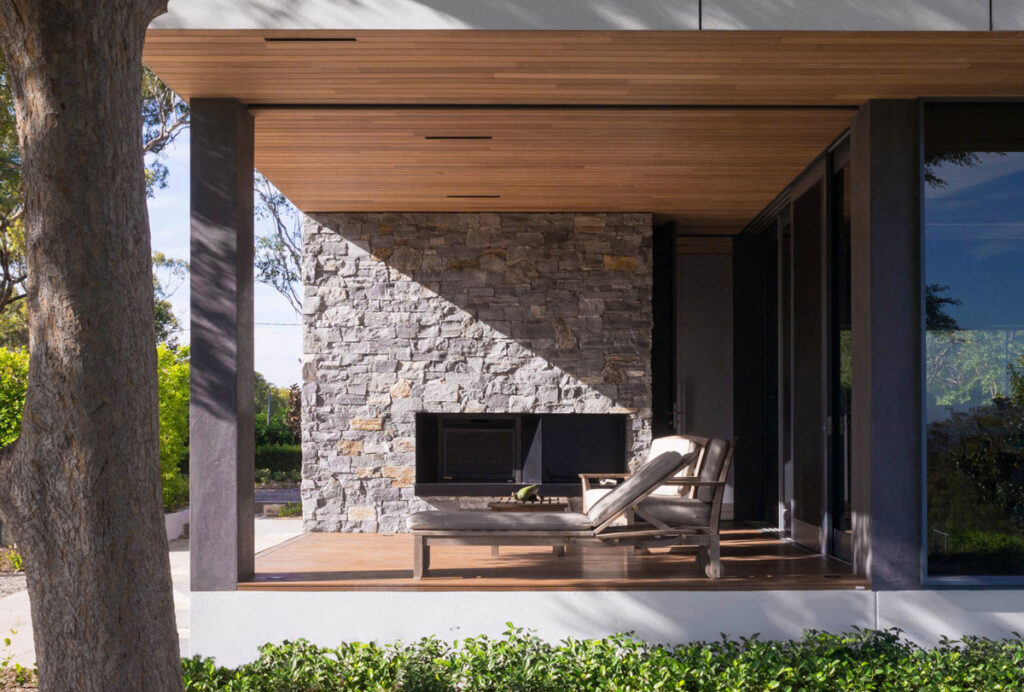
Costa Dry Stack Ledgestone used on an Outdoor Fireplace on Veranda
The front of the house is where most people stop. But your backyard should have wonderful stuff too.
Use Stone Veneer Siding on:
A patio privacy or seating wall
A fireplace on a covered patio surround
An outdoor kitchen backdrop for continuity
This is when your outside area and the outside of your house start to look like one “whole design”, even seamlessly flowing into interior design elements as well. Costa Drystack Ledgestone on this outdoor fireplace makes it the perfect addition to a nice covered patio.
Pros and Cons of Stone Veneer Siding
Cons
Cost: It’s usually more pricey than conventional siding choices like stucco and fiber cement board.
Installation Complexity: It’s not just “nail it and go.” Details and installation guidelines are important.
Moisture Risk If Installed Incorrectly: Incorrect substrates, poor drainage and flashing details can lead to water damage behind the veneer.
Pros
Upscale Appearance: A style and feel that is more upscale than most sidings can match
Durabilty: Compared to traditional wood siding and many other siding choices, it is more resistant to the weather and needs less upkeep.
Design Versatility: Stone veneer offers a myriad of choices to consider and make your project unique, from stone type, color, size, and installation technique. Not to mention where you put the stone siding, from subtle accents to a complete facade.
Cost and Longevity of Stone Veneer Siding
Origin TerraForm Irregular Stone Veneer used around stunning coastal modern home
A world of design choices await for a stone veneer siding project, ranging from entire façades, columns, gables, and improvements to your backyard. Define your style, coverage area, and budget to get started and reach out to one of the stone experts at Surface Shop to help guide you through the world of stone veneer products they’ve curated, from panelized, outdoor-rated veneer systems that give you a high end without the hassle of traditional masonry, to more bespoke loose masonry options like Ashlar and Terraform for truly exceptional projects. Put Surface Shop’s 20 years of experience in the stone veneer industry to work for your next project today!
Still just in the research phase and looking for resources on costs? Check out our in-depth cost guidance for natural stone veneer siding by visiting our stone veneer siding cost guide (updated 2026)for a deep dive into that information.
Design and Aesthetics: Nature's Artistry at Play
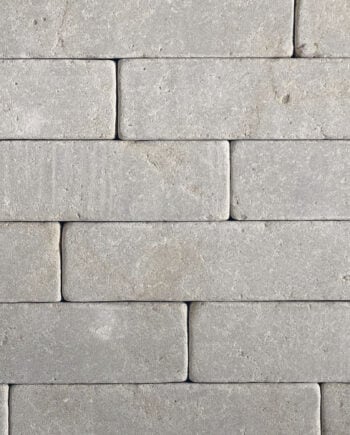
Luna Brushed Limestone Paving
Natural patterns, colors, and textures formed by the elements distinguish limestone from quartz in terms of attractiveness. These stones improve the overall appearance of any room by adding a distinctive visual appeal.
Frequently Asked Questions (FAQs)
What are the disadvantages of stone veneer siding?
Stone veneer siding can cost more than basic siding materials, requires proper installation to avoid moisture issues, and may need structural considerations depending on the wall system and coverage area.
Is stone veneer siding better than vinyl siding?
It depends on the project. Vinyl siding is typically cheaper, while natural stone veneer siding offers a more premium, timeless look and can increase perceived home value.
How long does stone veneer siding last?
When correctly installed and maintained, quality stone veneer siding is designed to last for decades, maintaining its texture and color over the long term.
Is stone veneer siding expensive?
Stone veneer siding usually costs more than vinyl or basic lap siding, but less than full-depth stone. Many homeowners use it strategically on key elevations or accent areas to maximize impact without covering the entire home.
Add a header to begin generating the table of contents
Our Top Selling Natural Stone Siding
Here’s a sampling of our materials that will serve you well for your Stone Siding needs. Contact a Surface Shop Pro today to get your samples and pricing.
At Surface Shop, we believe there is a story behind every surface. That’s why we created Surface Culture, an industry leading digital publication that covers a range of topics from How To Guides to Architectural Trends in the world of luxury architectural finishes Browse our articles to dial in your knowledge of how surfaces impact architectural design, or simply use them to get inspired. Either way, we hope you enjoy, and wish you well on your journey toward appreciating materiality in architecture.
Stepping stone walkway ideas for front entrances and gardens. See 6 layouts, plus spacing, base prep, and materials to help your path look great and last.
Natural stone veneer exterior wall panels can add texture and curb appeal to your home. Learn the key steps, tools, and tips for installing stone veneer on exterior walls.
Discover 10 stunning natural stone flooring ideas to elevate your home. From elegant marble to rugged slate, find the perfect style to suit your space.
Discover the most durable pavers for your next project. Explore top options that combine strength, longevity, and style to withstand the test of time and elements.